
Jim Warren is a recovering academic as retired adjunct professor and lecturer in environmental sociology at the University of Regina.
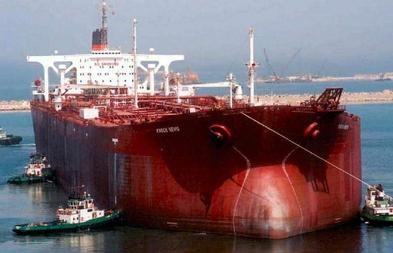
The world’s largest oil tanker in 1988, the Seawise Giant, being towed from dry dock at Dubai. This ship was sunk during the 80s tanker war, and then raised and refloated. Photo credit: Wikipedia public domain.
Introduction
It’s not surprising that with the world in the throes of a war in the Persian Gulf and a major energy supply disruption, people would like to see through the fog of conflict to get a handle on what the future has in store. What does it all mean and what does the future hold for the global economy and conventional energy?
While history may never precisely repeat itself, there are still insights, processes and repeating patterns from the past that can shine a light on today’s problems.
The report that follows assumes comparisons with similar events from the past can provide us with hints about where current events will take us and point out some of the errors from the past we may not want to repeat.
The report is also an effort to provide a brief history of oil crises from the past which combines the presentation of key events and a listing of production and price changes with the impacts those events and changes produced in the global economy.
Perhaps it can be your handy reference when looking for information about past energy shocks.
- 0120 2026 SK oil show attendee0120 2026 SK oil show attendee
- 0118 IBEW 30 sec0118 IBEW 30 sec
- 0119 Steffes Group System III Ltd Complete Dispersal P0119 Steffes Group System III Ltd Complete Dispersal P
- 0117 Turnbull 40 years0117 Turnbull 40 years
- 0115 SaskPower SASPO_2817_PLT_Recruitment_DIVERSITY0115 SaskPower SASPO_2817_PLT_Recruitment_DIVERSITY
- 0114 Prospera Bold Vision0114 Prospera Bold Vision
- 0113 Miller Epic Cinematic Hollywood trailer0113 Miller Epic Cinematic Hollywood trailer
- 0085 Turnbull snow removal call office0085 Turnbull snow removal call office
- 0102 Lori Carr Coal Extended0102 Lori Carr Coal Extended
- 0100 Turnbull Project Manager0100 Turnbull Project Manager
- 0099 Mryglod Steel 1080p0099 Mryglod Steel 1080p
- 0097 Eagle Sky Ventures LTD0097 Eagle Sky Ventures LTD
- 0095 Fast Trucking nearly 70 years good at it0095 Fast Trucking nearly 70 years good at it
- 0092 Turnbull projects big and small0092 Turnbull projects big and small
- 0046 City of Estevan This is Estevan Teaser0046 City of Estevan This is Estevan Teaser
- 0077 Caprice Resources Stand Up For Free Speech0077 Caprice Resources Stand Up For Free Speech
- 0061 SIMSA 2024 For Sask Buy Sask0061 SIMSA 2024 For Sask Buy Sask
- 0051 JML Hiring Pumpjack assembly0051 JML Hiring Pumpjack assembly
- 0049 Scotsburn Dental soft guitar0049 Scotsburn Dental soft guitar
- 0041 DEEP Since 2018 now we are going to build0041 DEEP Since 2018 now we are going to build
- 0032 IWS Summer hiring rock trailer music
- 0022 Grimes winter hiring
- 0021 OSY Rentals S8 Promo
- 0018 IWS Hiring Royal Summer
- 0013 Panther Drilling PO ad 03 top drive rigs
- 0002 gilliss casing services0002 gilliss casing services
- 9002 Pipeline Online 30 sec EBEX9002 Pipeline Online 30 sec EBEX
- 9001
1973-1974 Arab oil embargo and the first energy crisis of the 1970s
Direct cause
The Arab oil embargo, from Oct. 19, 1973 to March 1974, applied to countries that supported Israel during the Yom Kippur War (October 6 to 25, 1973). The embargo was led by Saudi Arabia and included other countries belonging to the international cartel, the Organization of the Petroleum Exporting Countries (OPEC). The embargoed countries initially included the US, Japan, Canada and the Netherlands.
Contributing causes
1) OPEC’s increased bargaining power: There was upward pressure on oil prices beginning a few years before the embargo and continuing for several years after the embargo ended. Higher prices were the result of efforts by Arab states and other members of OPEC to capture additional revenues by virtue of their control over nearly half of the global oil exports. Western oil companies and their governments were reluctant to use force to reduce OPEC’s price demands. They were wary of threats by OPEC members to nationalize their oil and gas industries. At one point the Saudis threatened to light their oil fields on fire if Western nations attempted to seize them by force.
2) Nationalization wasn’t an empty threat. The corporate takeovers began in 1973 with Saudi Arabia’s campaign to own the Arabian American Oil Company (Aramco). The Saudis acquired a 25 percent stake in the company in 1973. They increased their ownership to 60 percent in 1974. And, in 1980, the Saudis claimed 100 percent ownership of Aramco changing the company’s name to Saudi Aramco. Other OPEC members followed suit. For example, Venezuela nationalized its oil industry in 1976. The capacity of OPEC members to set or at least heavily influence floor prices for oil increased accordingly, until the mid to late 1980s when new discoveries and production increases in non-OPEC countries reduced, but did not eliminate, the cartel’s influence.
Global supply reduction of 6.0 percent
During the period from the end of 1972 until the close of 1974 total oil production for OPEC member states declined by 1.327 billion barrels (Bb). Virtually all of that decline can be attributed to the Arab members of OPEC that border the Persian Gulf. The reduction in the global supply of oil due to the embargo amounts to 6.0 percent.
The US was not self-sufficient in oil in 1973-1974, importing approximately 25 percent of the oil it consumed came from the Middle East. This would be the first time a global superpower was credibly threatened economically by reductions in the supply of oil available from countries bordering the Persian Gulf.
- 0120 2026 SK oil show attendee0120 2026 SK oil show attendee
- 0118 IBEW 30 sec0118 IBEW 30 sec
- 0119 Steffes Group System III Ltd Complete Dispersal P0119 Steffes Group System III Ltd Complete Dispersal P
- 0117 Turnbull 40 years0117 Turnbull 40 years
- 0115 SaskPower SASPO_2817_PLT_Recruitment_DIVERSITY0115 SaskPower SASPO_2817_PLT_Recruitment_DIVERSITY
- 0114 Prospera Bold Vision0114 Prospera Bold Vision
- 0113 Miller Epic Cinematic Hollywood trailer0113 Miller Epic Cinematic Hollywood trailer
- 0085 Turnbull snow removal call office0085 Turnbull snow removal call office
- 0102 Lori Carr Coal Extended0102 Lori Carr Coal Extended
- 0100 Turnbull Project Manager0100 Turnbull Project Manager
- 0099 Mryglod Steel 1080p0099 Mryglod Steel 1080p
- 0097 Eagle Sky Ventures LTD0097 Eagle Sky Ventures LTD
- 0095 Fast Trucking nearly 70 years good at it0095 Fast Trucking nearly 70 years good at it
- 0092 Turnbull projects big and small0092 Turnbull projects big and small
- 0046 City of Estevan This is Estevan Teaser0046 City of Estevan This is Estevan Teaser
- 0077 Caprice Resources Stand Up For Free Speech0077 Caprice Resources Stand Up For Free Speech
- 0061 SIMSA 2024 For Sask Buy Sask0061 SIMSA 2024 For Sask Buy Sask
- 0051 JML Hiring Pumpjack assembly0051 JML Hiring Pumpjack assembly
- 0049 Scotsburn Dental soft guitar0049 Scotsburn Dental soft guitar
- 0041 DEEP Since 2018 now we are going to build0041 DEEP Since 2018 now we are going to build
- 0032 IWS Summer hiring rock trailer music
- 0022 Grimes winter hiring
- 0021 OSY Rentals S8 Promo
- 0018 IWS Hiring Royal Summer
- 0013 Panther Drilling PO ad 03 top drive rigs
- 0002 gilliss casing services0002 gilliss casing services
- 9002 Pipeline Online 30 sec EBEX9002 Pipeline Online 30 sec EBEX
- 9001
Conservation initiatives
The oil supply remained lower than demand for several months, prompting a number of countries to implement consumer rationing programs. Fuel and electrical energy conservation initiatives were launched. For example, the US and Canada reduced the speed limits on highways and many Western developed countries banned Christmas lights. Other measures fostering conservation was the adoption of natural gas for heating homes and commercial buildings. Retrofitting buildings by installing additional insulation and energy conserving windows also helped reduce demand. The 1970s were a period when smaller, more fuel efficient vehicles became popular.
Price effects
In September 1973, the month prior to the embargo the price of WTI crude was $4.31 per barrel. By the spring of 1974 the price more than doubled, rising to $10.11 by June. The world price continued to rise in each of the next four years reaching $14.85 in November of 1978. As noted above, a more aggressive OPEC and threats by Arab governments to nationalize their oil industries forced higher prices onto the international oil companies operating in the Middle East.
Economic impacts
The oil price increases that occurred during and following the embargo led to nearly a decade of double digit inflation. The inflation contributed to a deep and lengthy global economic downturn affecting most developed countries. The rate of GDP growth for 1973 was a robust 6.4 percent. The global GDP growth rate fell to 2 percent in 1974 and bottomed out at 0.6 percent in 1975, returning to a healthier growth rate of 5.2 percent in 1976.
The search for new sources of oil
Not surprisingly, oil and natural gas producers sought to increase supplies from non-OPEC countries following the embargo. In 1977, the Trans-Alaska pipeline was completed linking the massive oil field at Prudhoe Bay on the Arctic coast with Port Valdez on the Alaska panhandle, increasing US oil production by 2.0 million bpd. More offshore oil was brought on stream in the Gulf of Mexico. The spike in global prices stimulated new production from oil and gas fields in the North Sea. Wells in the famous Brent Field went into production in 1976. Alberta’s oil sands did not begin adding significantly to the global supply until the last half of the 1990s—the real boom in oil sands production didn’t take off until the early 2000s, surpassing 2.7 million bpd by 2017.
- 0120 2026 SK oil show attendee0120 2026 SK oil show attendee
- 0118 IBEW 30 sec0118 IBEW 30 sec
- 0119 Steffes Group System III Ltd Complete Dispersal P0119 Steffes Group System III Ltd Complete Dispersal P
- 0117 Turnbull 40 years0117 Turnbull 40 years
- 0115 SaskPower SASPO_2817_PLT_Recruitment_DIVERSITY0115 SaskPower SASPO_2817_PLT_Recruitment_DIVERSITY
- 0114 Prospera Bold Vision0114 Prospera Bold Vision
- 0113 Miller Epic Cinematic Hollywood trailer0113 Miller Epic Cinematic Hollywood trailer
- 0085 Turnbull snow removal call office0085 Turnbull snow removal call office
- 0102 Lori Carr Coal Extended0102 Lori Carr Coal Extended
- 0100 Turnbull Project Manager0100 Turnbull Project Manager
- 0099 Mryglod Steel 1080p0099 Mryglod Steel 1080p
- 0097 Eagle Sky Ventures LTD0097 Eagle Sky Ventures LTD
- 0095 Fast Trucking nearly 70 years good at it0095 Fast Trucking nearly 70 years good at it
- 0092 Turnbull projects big and small0092 Turnbull projects big and small
- 0046 City of Estevan This is Estevan Teaser0046 City of Estevan This is Estevan Teaser
- 0077 Caprice Resources Stand Up For Free Speech0077 Caprice Resources Stand Up For Free Speech
- 0061 SIMSA 2024 For Sask Buy Sask0061 SIMSA 2024 For Sask Buy Sask
- 0051 JML Hiring Pumpjack assembly0051 JML Hiring Pumpjack assembly
- 0049 Scotsburn Dental soft guitar0049 Scotsburn Dental soft guitar
- 0041 DEEP Since 2018 now we are going to build0041 DEEP Since 2018 now we are going to build
- 0032 IWS Summer hiring rock trailer music
- 0022 Grimes winter hiring
- 0021 OSY Rentals S8 Promo
- 0018 IWS Hiring Royal Summer
- 0013 Panther Drilling PO ad 03 top drive rigs
- 0002 gilliss casing services0002 gilliss casing services
- 9002 Pipeline Online 30 sec EBEX9002 Pipeline Online 30 sec EBEX
- 9001
1979-1988 The second energy crisis: the 1979 Iranian Revolution; the Iran-Iraq War 1980– 1988 and the Tanker War 1984-1988
Direct causes
Revolution, war and production cuts
1) Iranian Revolution: A significant proportion of Iranians had been angry with the regime of Shah Reza Pahlavi since the 1960s when Pahlavi introduced a modernization, aka Westernization, program; especially angry were clerics and devout Muslims. Even more secular Iranians viewed the Shah’s regime as corrupt and viciously oppressive. Following the killing of anti-government protesters in October 1977 unrest spread throughout the country, culminating in the overthrow of the Shah’s regime in March 1979. The monarchy was replaced with an Islamic republic headed by the Shia cleric, Ayatollah Ruhollah Khomeini. The mass protests and a succession of general strikes in 1978 and 1979 paralyzed Iranian oil production reducing the global supply.
2) Iran-Iraq War: President Saddam Hussein of Iraq, feared the new Iranian regime would export enthusiasm for establishing an Islamic theocracy to Iraq’s large Shia minority. To forestall a possible Shia rebellion supported by Iran, Saddam invaded Iran in September of 1980. He imagined a decisive victory would stifle the expansion of Islamic republicanism and make Iraq the dominant power in the Persian Gulf. By 1981, the war degenerated into a brutal stalemate featuring trench warfare and chemical weapons attacks, reminiscent of World War I.
3) The Tanker War: The stalemate spawned new tactical approaches. And, in early 1984 Iraq began bombing oil terminals and ships doing business with Iran including oil tankers. By May of 1984, Iran was responding in kind.
4) Saudi Arabia’s production cuts: The big decline in Persian Gulf oil production between 1977 and 1986 was not solely due to the effects of war and revolution. Obviously, damaging attacks on 451 oil tankers and other commercial vessels in the space of four years had a negative effect on tanker traffic. But, Saudi Arabia’s decision to cut its production and exports after 1980 may have had a more significant impact. The Saudis considered oil prices had been too low from the late 1970s up to 1980. They were determined to significantly reduce their production thereby creating a supply shortfall that would drive up prices—and it worked, the world price rose to $38 per barrel by 1981.
The Saudis expected other OPEC member states to cooperate with them by making their own production cuts. It turned out the other OPEC members forgot what a cartel was for and did not make meaningful production cuts. For their part, the Saudis reduced their production in stages from 3.760 billion barrels per year Bb/y0 in 1980 down to 1.004Bb/y for 1985. The Saudis discovered that there comes a point when volumes are so low that oil revenues tank despite higher prices. There also came a point when the Saudis became fed up with the free riding practices of their OPEC “partners.” Saudi production doubled in 1986, increasing from 1.004 Bb/y to 2.008Bp/y. Global oil prices fell accordingly from $29.75pb in 1985 to just $10.00pb.
Within the space of a single year the Saudis realized they had over-corrected. They reversed themselves, increasing production to 2.008 Bp/y. Prices began to recover after 1986, reaching $20 per barrel by November 1989.
- 0120 2026 SK oil show attendee0120 2026 SK oil show attendee
- 0118 IBEW 30 sec0118 IBEW 30 sec
- 0119 Steffes Group System III Ltd Complete Dispersal P0119 Steffes Group System III Ltd Complete Dispersal P
- 0117 Turnbull 40 years0117 Turnbull 40 years
- 0115 SaskPower SASPO_2817_PLT_Recruitment_DIVERSITY0115 SaskPower SASPO_2817_PLT_Recruitment_DIVERSITY
- 0114 Prospera Bold Vision0114 Prospera Bold Vision
- 0113 Miller Epic Cinematic Hollywood trailer0113 Miller Epic Cinematic Hollywood trailer
- 0085 Turnbull snow removal call office0085 Turnbull snow removal call office
- 0102 Lori Carr Coal Extended0102 Lori Carr Coal Extended
- 0100 Turnbull Project Manager0100 Turnbull Project Manager
- 0099 Mryglod Steel 1080p0099 Mryglod Steel 1080p
- 0097 Eagle Sky Ventures LTD0097 Eagle Sky Ventures LTD
- 0095 Fast Trucking nearly 70 years good at it0095 Fast Trucking nearly 70 years good at it
- 0092 Turnbull projects big and small0092 Turnbull projects big and small
- 0046 City of Estevan This is Estevan Teaser0046 City of Estevan This is Estevan Teaser
- 0077 Caprice Resources Stand Up For Free Speech0077 Caprice Resources Stand Up For Free Speech
- 0061 SIMSA 2024 For Sask Buy Sask0061 SIMSA 2024 For Sask Buy Sask
- 0051 JML Hiring Pumpjack assembly0051 JML Hiring Pumpjack assembly
- 0049 Scotsburn Dental soft guitar0049 Scotsburn Dental soft guitar
- 0041 DEEP Since 2018 now we are going to build0041 DEEP Since 2018 now we are going to build
- 0032 IWS Summer hiring rock trailer music
- 0022 Grimes winter hiring
- 0021 OSY Rentals S8 Promo
- 0018 IWS Hiring Royal Summer
- 0013 Panther Drilling PO ad 03 top drive rigs
- 0002 gilliss casing services0002 gilliss casing services
- 9002 Pipeline Online 30 sec EBEX9002 Pipeline Online 30 sec EBEX
- 9001
A couple of interesting insights from the production reduction story
1) A relatively modest increase, decrease or disruption in the global supply of petroleum can have an over-sized effect on prices. Jumping a bit ahead to the 1990—1991 Gulf War, 1.670 Bb of crude was removed from what was the 1989 global pre-war annual total of 23.648 Bb, amounting to a 7.0 percent removal of production from the global supply for one year. That 7.0 percent disruption in the global supply produced a 50 percent increase in the world price. Prices for WTI rose from $19.66 pb in late 1989 to $39.53 pb by September 1990.
2) During the 1984—1988 Tanker War, despite there being an average of 100 attacks per year that caused damage to large commercial ships, the Strait of Hormuz was not closed to shipping during the war. Were merchant seamen less risk averse in the 1980s than they are today? Were insurers more blasé about losses? Most likely the maintenance of shipping in the Gulf was due to the fact the Iranians and Iraqis were primarily focused on destroying each other’s oil terminals and attacking ships transporting oil and other goods to and from each other’s ports. Even so, some vessels servicing other Persian Gulf countries were attacked.
- 0120 2026 SK oil show attendee0120 2026 SK oil show attendee
- 0118 IBEW 30 sec0118 IBEW 30 sec
- 0119 Steffes Group System III Ltd Complete Dispersal P0119 Steffes Group System III Ltd Complete Dispersal P
- 0117 Turnbull 40 years0117 Turnbull 40 years
- 0115 SaskPower SASPO_2817_PLT_Recruitment_DIVERSITY0115 SaskPower SASPO_2817_PLT_Recruitment_DIVERSITY
- 0114 Prospera Bold Vision0114 Prospera Bold Vision
- 0113 Miller Epic Cinematic Hollywood trailer0113 Miller Epic Cinematic Hollywood trailer
- 0085 Turnbull snow removal call office0085 Turnbull snow removal call office
- 0102 Lori Carr Coal Extended0102 Lori Carr Coal Extended
- 0100 Turnbull Project Manager0100 Turnbull Project Manager
- 0099 Mryglod Steel 1080p0099 Mryglod Steel 1080p
- 0097 Eagle Sky Ventures LTD0097 Eagle Sky Ventures LTD
- 0095 Fast Trucking nearly 70 years good at it0095 Fast Trucking nearly 70 years good at it
- 0092 Turnbull projects big and small0092 Turnbull projects big and small
- 0046 City of Estevan This is Estevan Teaser0046 City of Estevan This is Estevan Teaser
- 0077 Caprice Resources Stand Up For Free Speech0077 Caprice Resources Stand Up For Free Speech
- 0061 SIMSA 2024 For Sask Buy Sask0061 SIMSA 2024 For Sask Buy Sask
- 0051 JML Hiring Pumpjack assembly0051 JML Hiring Pumpjack assembly
- 0049 Scotsburn Dental soft guitar0049 Scotsburn Dental soft guitar
- 0041 DEEP Since 2018 now we are going to build0041 DEEP Since 2018 now we are going to build
- 0032 IWS Summer hiring rock trailer music
- 0022 Grimes winter hiring
- 0021 OSY Rentals S8 Promo
- 0018 IWS Hiring Royal Summer
- 0013 Panther Drilling PO ad 03 top drive rigs
- 0002 gilliss casing services0002 gilliss casing services
- 9002 Pipeline Online 30 sec EBEX9002 Pipeline Online 30 sec EBEX
- 9001
Global supply changes 1978-1989
The historical record for oil production by Persian Gulf countries from 1978 to 1979 is a bit of a hot mess. The problem is due in part to a lack of consistency among analysts in determining the baseline production levels being used to compare against production shortfalls. For example, a US Federal Reserve report that came out this year uses only 1979 and 1980 global oil production data to describe the extent of the supply shortfall generated by the Iranian Revolution and the Iran-Iraq war. They claim the shortfall was a paltry four percent and use that figure to compare the magnitude of the 1979 to 1988 oil crisis to the current war in the Persian Gulf. Their lowball figure adds emphasis to their contention that today’s oil shortage is of a much greater magnitude than those going back to the 1973-74 embargo.
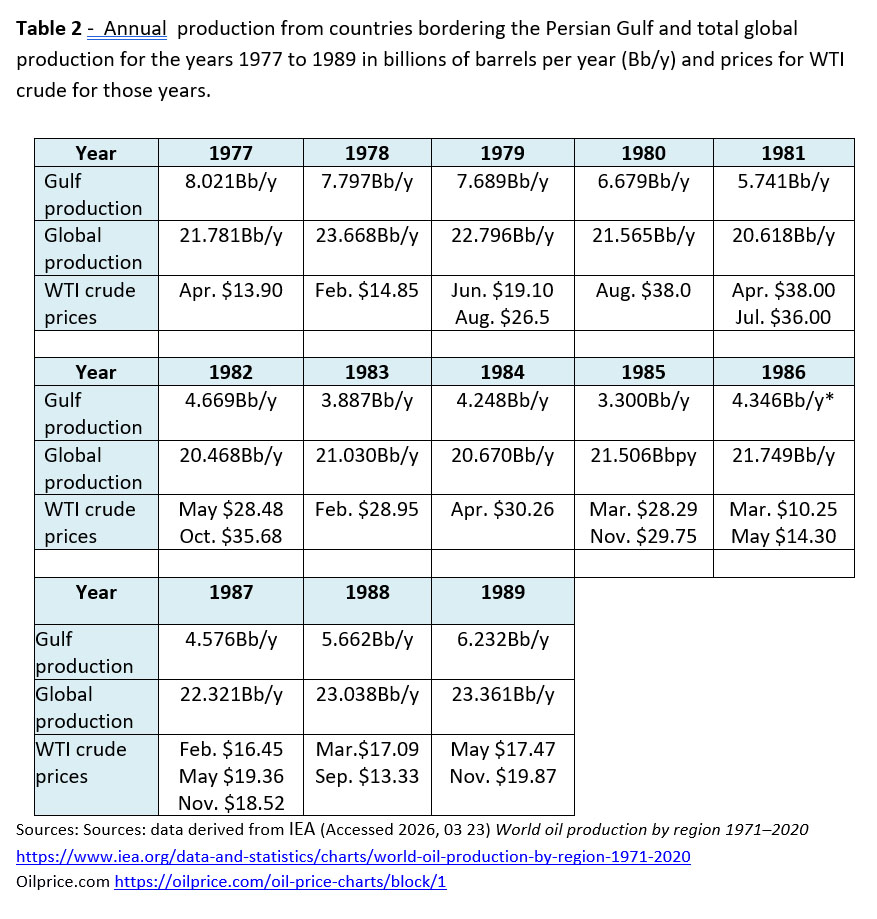
When we check the production data from 1978 up to the end of the Iran-Iraq War a far different picture emerges. It is true that production of Persian Gulf oil fell by only 4.7 percent from 1977 to 1980—a number relatively close to the four percent indicated by the Federal Reserve.
However, when we look a bit further into the 1980s we find Gulf production fell from 8.021Bb/y for 1977 to just 3.3 Bb/y in 1985 as a decline of 58.9 percent. The fall in Persian Gulf production amounted to a decline in global oil production from 1977 to 1985 of a whopping 15%.
The year 1985 marked the lowest level of production for the Gulf states. Persian Gulf production levels increased each year after 1985 up until 1989, which was the first full year following the end of the Iran Iraq War and the Tanker War. By the end of 1989 production in the Gulf stood at 6.232 Bp/y. It had not yet returned to the 1977 pre-crisis level of 8.021Bb/y.
Price effects
The WTI price for crude began to increase significantly in 1979, rising from $14.85pb in 1978 to $38.00pb in 1980. Prices ranged from $38.00pb in 1981 to $30.00pb in 1985, the year when Saudi Arabia doubled its oil production. In 1986, the year after the Saudis flooded the market, the price for WTI crude fell to $10.25 per barrel. Prices floated within the $17.00 per barrel to $20.00 per barrel range from 1987 to 1989. A more detailed look at prices is presented in Table 2 .
- 0120 2026 SK oil show attendee0120 2026 SK oil show attendee
- 0118 IBEW 30 sec0118 IBEW 30 sec
- 0119 Steffes Group System III Ltd Complete Dispersal P0119 Steffes Group System III Ltd Complete Dispersal P
- 0117 Turnbull 40 years0117 Turnbull 40 years
- 0115 SaskPower SASPO_2817_PLT_Recruitment_DIVERSITY0115 SaskPower SASPO_2817_PLT_Recruitment_DIVERSITY
- 0114 Prospera Bold Vision0114 Prospera Bold Vision
- 0113 Miller Epic Cinematic Hollywood trailer0113 Miller Epic Cinematic Hollywood trailer
- 0085 Turnbull snow removal call office0085 Turnbull snow removal call office
- 0102 Lori Carr Coal Extended0102 Lori Carr Coal Extended
- 0100 Turnbull Project Manager0100 Turnbull Project Manager
- 0099 Mryglod Steel 1080p0099 Mryglod Steel 1080p
- 0097 Eagle Sky Ventures LTD0097 Eagle Sky Ventures LTD
- 0095 Fast Trucking nearly 70 years good at it0095 Fast Trucking nearly 70 years good at it
- 0092 Turnbull projects big and small0092 Turnbull projects big and small
- 0046 City of Estevan This is Estevan Teaser0046 City of Estevan This is Estevan Teaser
- 0077 Caprice Resources Stand Up For Free Speech0077 Caprice Resources Stand Up For Free Speech
- 0061 SIMSA 2024 For Sask Buy Sask0061 SIMSA 2024 For Sask Buy Sask
- 0051 JML Hiring Pumpjack assembly0051 JML Hiring Pumpjack assembly
- 0049 Scotsburn Dental soft guitar0049 Scotsburn Dental soft guitar
- 0041 DEEP Since 2018 now we are going to build0041 DEEP Since 2018 now we are going to build
- 0032 IWS Summer hiring rock trailer music
- 0022 Grimes winter hiring
- 0021 OSY Rentals S8 Promo
- 0018 IWS Hiring Royal Summer
- 0013 Panther Drilling PO ad 03 top drive rigs
- 0002 gilliss casing services0002 gilliss casing services
- 9002 Pipeline Online 30 sec EBEX9002 Pipeline Online 30 sec EBEX
- 9001
Statistical methodology
(readers not enamoured with data analysis might want to skip this section)
Rather than overwhelm and bore everyone with a deluge of numbers, I have placed two tables in the Annex provided at the end of this article. The first, Table 1, presents annual Persian Gulf production data by country from 1977 to 1989 and shows the percentages for the changes in Gulf production over the period. The table also shows the percentage decrease or increase in global production for each year.
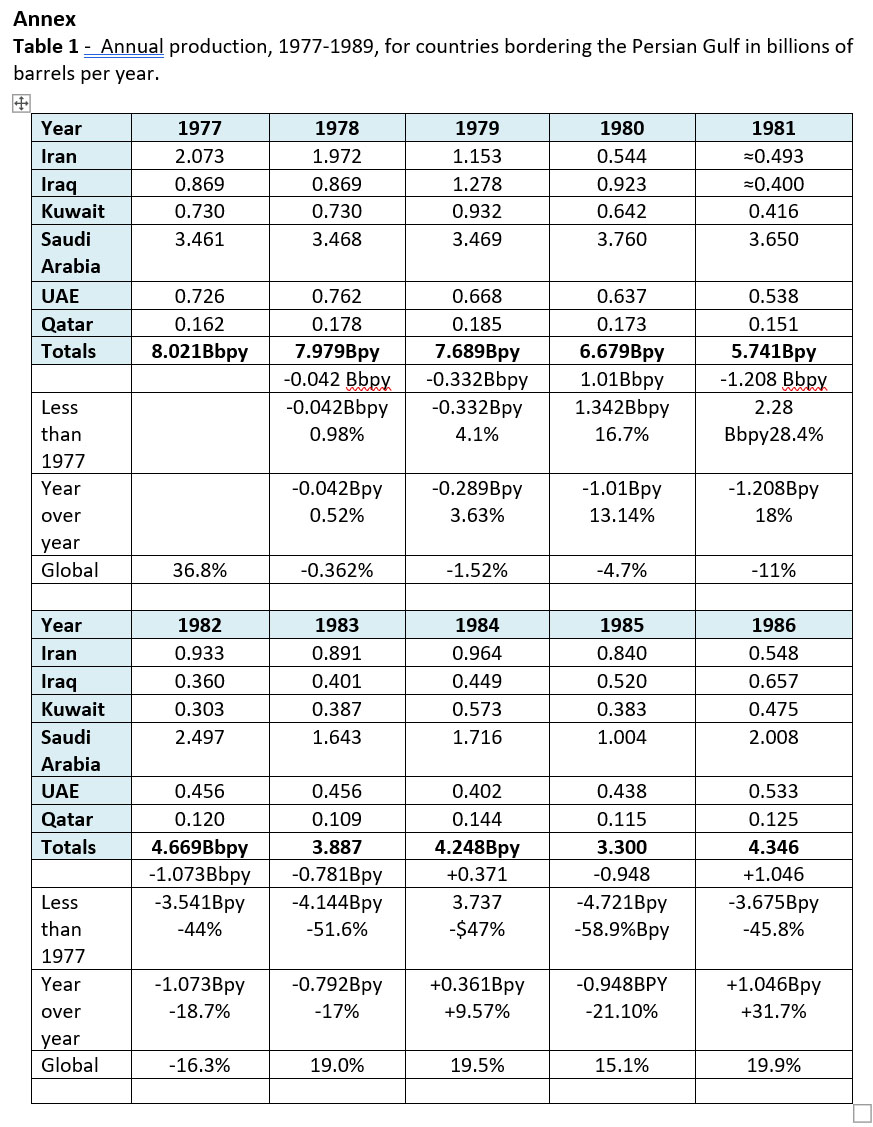
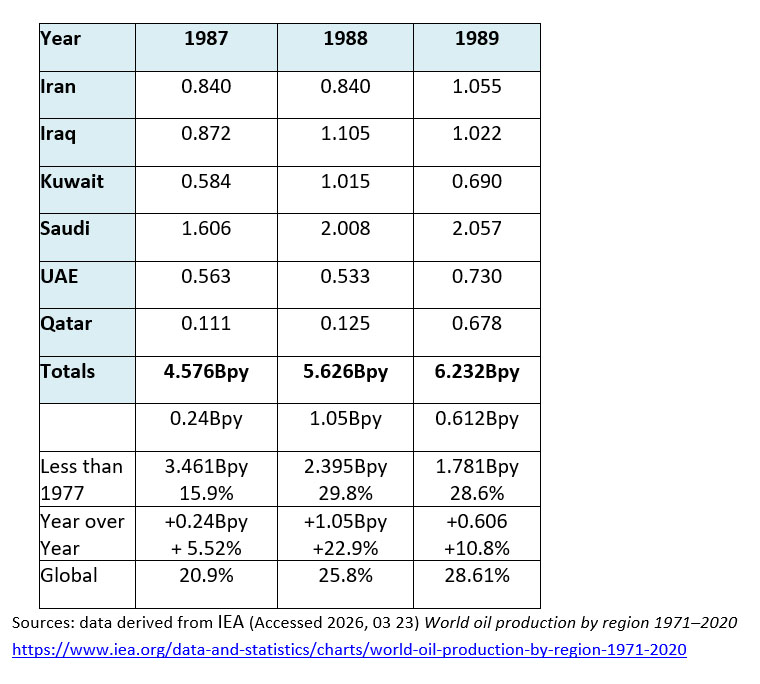
Table 2 presents the annual figures for Gulf and global production from 1977 to 1989 along with the price changes that occurred in conjunction with the supply changes.
To describe the extent of the post-1978 supply decrease, I have followed the method currently being employed by journalists, government leaders, as well as business and political commentators. When discussing today’s oil and LNG supply shortages they compare the situation during the five weeks following the February 28 outbreak of the current war, with the size of global oil production in the period just prior to the start of the conflict.
For example, early in the conflict reporters explained the war was causing a reduction of oil available to the world from the Persian Gulf of 20 million bpd. That amount conveniently matched up with the fact the Gulf supplied 20 percent of global production prior to the war. Some journalists have figured out that the 20 million b/d number is too high. It fails to account for the 6.0 to 7.0 million barrels per day which can avoid the Persian Gulf by using Saudi Arabia’s East-West pipeline to the Red Sea. This means that only around 13.5 million b/d has been stranded in the Gulf by the war. Nevertheless there are mainstream media personalities who have stuck to the 20 million b/d total.
Resolution
The Tanker War did not end until August of 1988 and the signing of an UN-negotiated ceasefire agreement ending the Iran-Iraq War. But that was too late for the 451 commercial vessels that had been struck and damaged, the 11 ships that had been sunk and the more than 100 merchant sailors who had been killed. While Persian Gulf production did not recover to pre-1979 levels until the early 2000s, growth in total annual global production on the part of non-OPEC countries made up for the slow pace of recovery for the Gulf countries.
- 0120 2026 SK oil show attendee0120 2026 SK oil show attendee
- 0118 IBEW 30 sec0118 IBEW 30 sec
- 0119 Steffes Group System III Ltd Complete Dispersal P0119 Steffes Group System III Ltd Complete Dispersal P
- 0117 Turnbull 40 years0117 Turnbull 40 years
- 0115 SaskPower SASPO_2817_PLT_Recruitment_DIVERSITY0115 SaskPower SASPO_2817_PLT_Recruitment_DIVERSITY
- 0114 Prospera Bold Vision0114 Prospera Bold Vision
- 0113 Miller Epic Cinematic Hollywood trailer0113 Miller Epic Cinematic Hollywood trailer
- 0085 Turnbull snow removal call office0085 Turnbull snow removal call office
- 0102 Lori Carr Coal Extended0102 Lori Carr Coal Extended
- 0100 Turnbull Project Manager0100 Turnbull Project Manager
- 0099 Mryglod Steel 1080p0099 Mryglod Steel 1080p
- 0097 Eagle Sky Ventures LTD0097 Eagle Sky Ventures LTD
- 0095 Fast Trucking nearly 70 years good at it0095 Fast Trucking nearly 70 years good at it
- 0092 Turnbull projects big and small0092 Turnbull projects big and small
- 0046 City of Estevan This is Estevan Teaser0046 City of Estevan This is Estevan Teaser
- 0077 Caprice Resources Stand Up For Free Speech0077 Caprice Resources Stand Up For Free Speech
- 0061 SIMSA 2024 For Sask Buy Sask0061 SIMSA 2024 For Sask Buy Sask
- 0051 JML Hiring Pumpjack assembly0051 JML Hiring Pumpjack assembly
- 0049 Scotsburn Dental soft guitar0049 Scotsburn Dental soft guitar
- 0041 DEEP Since 2018 now we are going to build0041 DEEP Since 2018 now we are going to build
- 0032 IWS Summer hiring rock trailer music
- 0022 Grimes winter hiring
- 0021 OSY Rentals S8 Promo
- 0018 IWS Hiring Royal Summer
- 0013 Panther Drilling PO ad 03 top drive rigs
- 0002 gilliss casing services0002 gilliss casing services
- 9002 Pipeline Online 30 sec EBEX9002 Pipeline Online 30 sec EBEX
- 9001
Economic impacts
When the oil shocks initiated by the Iranian Revolution and the Iran-Iraq War occurred, rich, developed Western countries had not fully recovered from the high inflation and stagnant economy of the 1970s. Making matters worse, in 1979 the US Federal Reserve got a new chairman, Paul Volcker, who was obsessed with radically reducing inflation and doing it quickly. Volcker’s solution was to use exceedingly high interest rate increases to drive down inflation. Unfortunately, the central bankers of many other Western countries followed where the US led. By 1980, Volcker had raised prime interest rates in the US so high that five-year fixed mortgage rates in the US hit 18.75 percent.
The Bank of Canada got on board with the Volcker strategy for battling inflation. By 1981, interest rates for five-year fixed mortgages hit nosebleed heights—peaking at 21.5 percent.
Volcker and his international disciples had overcorrected. The cure was almost as bad as the disease. High interest rates themselves became an inflationary job killing menace. Many of the world’s big economies were teetering on the brink of an economic recession right when the oil shock of 1979 arrived. Oil shortages and big price increases heralded the arrival of a worldwide recession in 1981 and 1982.
It just goes to show simply because someone is head of a central bank does not mean they are inspired economic prophets or that they don’t have wacky ideas. Canadians might have benefited from knowing this prior to voting in the 2025 federal election. The housing construction industry in the US and Canada collapsed, throwing thousands out of work. The spike in interest rates in 1980 and 1981 led to the eventual collapse of the huge US Savings and Loan Association sector. Savings and loan groups in many parts of the US had been offering reduced rates mortgages to their customers to encourage borrowing.
By the end of 1981 around one-third of US Savings and Loan associations were bankrupt. Recession conditions lifted after 1982. Part of the solution was reducing the maniacal interest rate hikes. Allan Greenspan replaced Paul Volcker as Federal Reserve chair in 1989 and began a staged reduction in interest rates.
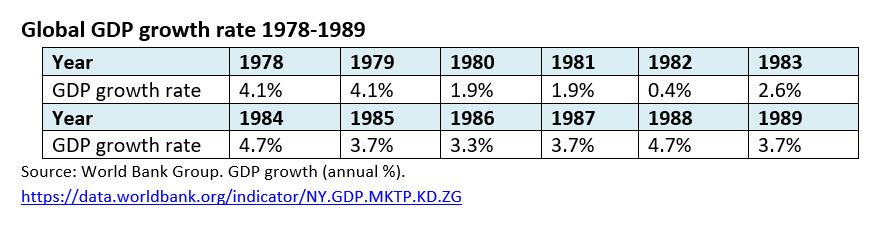
The following table indicates that in 1978, the year prior to the peak of unrest during the Iranian Revolution the rate of growth for global GDP was 4.1 percent. The growth rate continued to decline in concert with the ongoing decreases in production, high oil prices and the arrival of the early 1980s recession.
Impacts on Alberta
Albertans suffered a double whammy of sky-high mortgage rates and recession conditions at the same time as they were being hammered by the federal government’s imposition of the National Energy Program (NEP). Among the NEP’s more egregious conditions was the placing of a price cap on oil produced and sold in Canada. The price Albertans could obtain for domestically consumed oil was not allowed to exceed 85 percent of the international market price. The NEP effectively prevented Albertans from at least enjoying the full benefit of higher global oil prices. Oil exploration and drilling shut down and unemployment soared. People who could no longer afford their mortgages threw the keys back at the bankers. Two Alberta banks and went broke in the 1985.
1990–1991 The First US-led Gulf War
The War
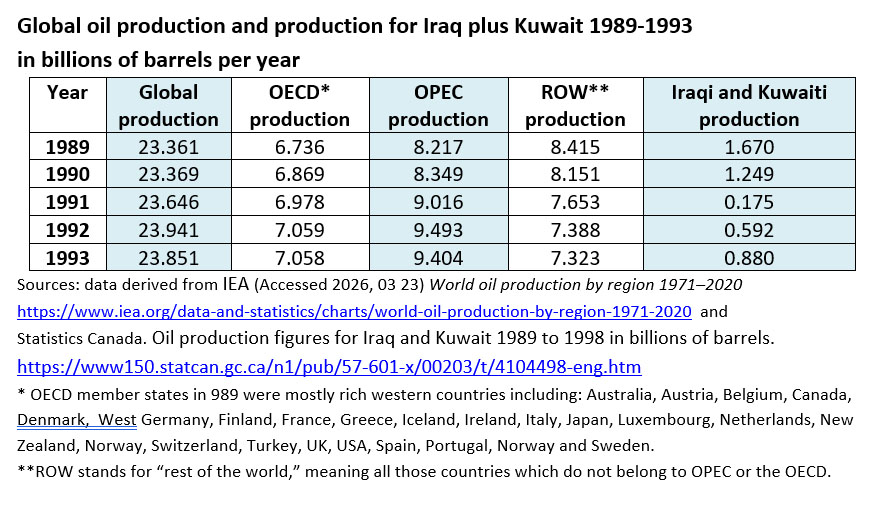
Iraqi armed forces invaded and occupied Iraq’s neighbor Kuwait in August of 1990. Both Iraq and Kuwait are oil rich states with Persian Gulf shorelines. The Iraqi invasion was unprovoked, despite Iraqi strong man Saddam Hussein’s fabricated acts of Kuwaiti economic aggression. Saddam’s invasion was an imperialist move engineered to take possession of Kuwaiti oil production and to provide a potential launch pad for the Iraqi conquest of Saudi Arabia. In response, the UN Security Council promptly authorized a naval blockade of Iraqi and Kuwaiti ports on the Persian Gulf and placed an embargo on oil exports from either country. Prior to 1990 and the embargo on exports, the combined oil production of the two countries was 1.670Bb/y.
In November, the Security Council presented Saddam with an ultimatum, leave Kuwait by January 15, 1991 or face being evicted by force if required. Accordingly, a 42 member coalition of countries led by the United States was formed and began preparing for the possibility of forcefully expelling the Iraqis from Kuwait. Saddam did not comply with the UN ultimatum and on January 16 the coalition launched operation Desert Storm to force an Iraqi withdrawal. The Iraqis suffered a stunning defeat. Their death toll was estimated to be from 20,000 to 50,000 soldiers and civilians—compared to the deaths of only 292 coalition soldiers.
- 0120 2026 SK oil show attendee0120 2026 SK oil show attendee
- 0118 IBEW 30 sec0118 IBEW 30 sec
- 0119 Steffes Group System III Ltd Complete Dispersal P0119 Steffes Group System III Ltd Complete Dispersal P
- 0117 Turnbull 40 years0117 Turnbull 40 years
- 0115 SaskPower SASPO_2817_PLT_Recruitment_DIVERSITY0115 SaskPower SASPO_2817_PLT_Recruitment_DIVERSITY
- 0114 Prospera Bold Vision0114 Prospera Bold Vision
- 0113 Miller Epic Cinematic Hollywood trailer0113 Miller Epic Cinematic Hollywood trailer
- 0085 Turnbull snow removal call office0085 Turnbull snow removal call office
- 0102 Lori Carr Coal Extended0102 Lori Carr Coal Extended
- 0100 Turnbull Project Manager0100 Turnbull Project Manager
- 0099 Mryglod Steel 1080p0099 Mryglod Steel 1080p
- 0097 Eagle Sky Ventures LTD0097 Eagle Sky Ventures LTD
- 0095 Fast Trucking nearly 70 years good at it0095 Fast Trucking nearly 70 years good at it
- 0092 Turnbull projects big and small0092 Turnbull projects big and small
- 0046 City of Estevan This is Estevan Teaser0046 City of Estevan This is Estevan Teaser
- 0077 Caprice Resources Stand Up For Free Speech0077 Caprice Resources Stand Up For Free Speech
- 0061 SIMSA 2024 For Sask Buy Sask0061 SIMSA 2024 For Sask Buy Sask
- 0051 JML Hiring Pumpjack assembly0051 JML Hiring Pumpjack assembly
- 0049 Scotsburn Dental soft guitar0049 Scotsburn Dental soft guitar
- 0041 DEEP Since 2018 now we are going to build0041 DEEP Since 2018 now we are going to build
- 0032 IWS Summer hiring rock trailer music
- 0022 Grimes winter hiring
- 0021 OSY Rentals S8 Promo
- 0018 IWS Hiring Royal Summer
- 0013 Panther Drilling PO ad 03 top drive rigs
- 0002 gilliss casing services0002 gilliss casing services
- 9002 Pipeline Online 30 sec EBEX9002 Pipeline Online 30 sec EBEX
- 9001
After the war
The end of fighting did not mean there would be a quick return to former production levels. An oil spill had to be cleaned up. The Iraqis had tampered with Kuwait’s coastal pipelines causing oil to flow for weeks into the Red Sea. It was the largest coastal oil spill ever to occur before 1991.
The Iraqis had also lit most of Kuwait’s oil wells on fire before being expelled from the country. It took 10 months to extinguish all of the fires. Furthermore, the UN imposed punitive oil export sanctions on Iraq, its exports were cut by 75 percent until the sanctions expired in 1997.
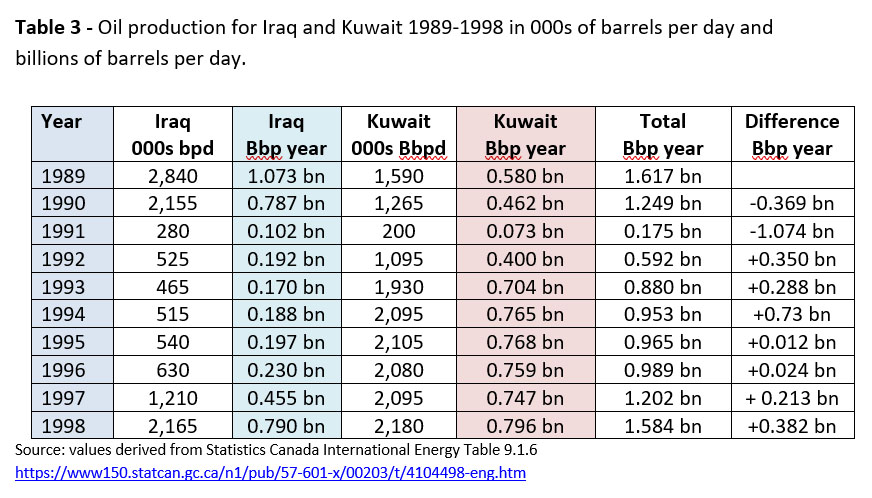
The following table gives an overview of the decreases in production associated with Iraq’s invasion of Kuwait. Table 3 provides additional details on this topic.
- 0120 2026 SK oil show attendee0120 2026 SK oil show attendee
- 0118 IBEW 30 sec0118 IBEW 30 sec
- 0119 Steffes Group System III Ltd Complete Dispersal P0119 Steffes Group System III Ltd Complete Dispersal P
- 0117 Turnbull 40 years0117 Turnbull 40 years
- 0115 SaskPower SASPO_2817_PLT_Recruitment_DIVERSITY0115 SaskPower SASPO_2817_PLT_Recruitment_DIVERSITY
- 0114 Prospera Bold Vision0114 Prospera Bold Vision
- 0113 Miller Epic Cinematic Hollywood trailer0113 Miller Epic Cinematic Hollywood trailer
- 0085 Turnbull snow removal call office0085 Turnbull snow removal call office
- 0102 Lori Carr Coal Extended0102 Lori Carr Coal Extended
- 0100 Turnbull Project Manager0100 Turnbull Project Manager
- 0099 Mryglod Steel 1080p0099 Mryglod Steel 1080p
- 0097 Eagle Sky Ventures LTD0097 Eagle Sky Ventures LTD
- 0095 Fast Trucking nearly 70 years good at it0095 Fast Trucking nearly 70 years good at it
- 0092 Turnbull projects big and small0092 Turnbull projects big and small
- 0046 City of Estevan This is Estevan Teaser0046 City of Estevan This is Estevan Teaser
- 0077 Caprice Resources Stand Up For Free Speech0077 Caprice Resources Stand Up For Free Speech
- 0061 SIMSA 2024 For Sask Buy Sask0061 SIMSA 2024 For Sask Buy Sask
- 0051 JML Hiring Pumpjack assembly0051 JML Hiring Pumpjack assembly
- 0049 Scotsburn Dental soft guitar0049 Scotsburn Dental soft guitar
- 0041 DEEP Since 2018 now we are going to build0041 DEEP Since 2018 now we are going to build
- 0032 IWS Summer hiring rock trailer music
- 0022 Grimes winter hiring
- 0021 OSY Rentals S8 Promo
- 0018 IWS Hiring Royal Summer
- 0013 Panther Drilling PO ad 03 top drive rigs
- 0002 gilliss casing services0002 gilliss casing services
- 9002 Pipeline Online 30 sec EBEX9002 Pipeline Online 30 sec EBEX
- 9001
The 1990 Oil Price Spike
The war caused a spike in oil prices. In June of 1990, WTI crude was selling for $17.8 per barrel. It would more than double by September, hitting $39.53 per barrel before the end of the year. The higher price regime didn’t last too long. Within a month of the war’s end the WTI price had fallen to $19.28 per barrel. The war ended with a ceasefire on February, 28 1991.
Supply chain disruption
The general increase in the world’s oil production underway by the early 1990s meant that the loss of exports from Iraq and Kuwait would eventually be resolved. But, in the short-term countries that had been regular customers of Iraq and Kuwait scrambled to find new suppliers. Their efforts to acquire oil normally available to other buyers undoubtedly had some effect on prices. It is possible that bad memories, acquired during the two previous oil supply and price crises, spooked the market. Spot market buyers, futures traders along with government demands to increase the amount held in reserves likely also contributed to a price spike.
Other global production changes
The loss of production associated with the Gulf War did result in a reduction in the world’s annual oil production for 1990 and 1991. This is because production was growing in other regions of the world. Increasing production from places like Alaska, the North Sea and other OPEC members was driving up annual increases in global production despite the loss of production from the Persian Gulf. They also more than compensated for the decline in production just prior to and following the collapse of the former Soviet Union.
- 0120 2026 SK oil show attendee0120 2026 SK oil show attendee
- 0118 IBEW 30 sec0118 IBEW 30 sec
- 0119 Steffes Group System III Ltd Complete Dispersal P0119 Steffes Group System III Ltd Complete Dispersal P
- 0117 Turnbull 40 years0117 Turnbull 40 years
- 0115 SaskPower SASPO_2817_PLT_Recruitment_DIVERSITY0115 SaskPower SASPO_2817_PLT_Recruitment_DIVERSITY
- 0114 Prospera Bold Vision0114 Prospera Bold Vision
- 0113 Miller Epic Cinematic Hollywood trailer0113 Miller Epic Cinematic Hollywood trailer
- 0085 Turnbull snow removal call office0085 Turnbull snow removal call office
- 0102 Lori Carr Coal Extended0102 Lori Carr Coal Extended
- 0100 Turnbull Project Manager0100 Turnbull Project Manager
- 0099 Mryglod Steel 1080p0099 Mryglod Steel 1080p
- 0097 Eagle Sky Ventures LTD0097 Eagle Sky Ventures LTD
- 0095 Fast Trucking nearly 70 years good at it0095 Fast Trucking nearly 70 years good at it
- 0092 Turnbull projects big and small0092 Turnbull projects big and small
- 0046 City of Estevan This is Estevan Teaser0046 City of Estevan This is Estevan Teaser
- 0077 Caprice Resources Stand Up For Free Speech0077 Caprice Resources Stand Up For Free Speech
- 0061 SIMSA 2024 For Sask Buy Sask0061 SIMSA 2024 For Sask Buy Sask
- 0051 JML Hiring Pumpjack assembly0051 JML Hiring Pumpjack assembly
- 0049 Scotsburn Dental soft guitar0049 Scotsburn Dental soft guitar
- 0041 DEEP Since 2018 now we are going to build0041 DEEP Since 2018 now we are going to build
- 0032 IWS Summer hiring rock trailer music
- 0022 Grimes winter hiring
- 0021 OSY Rentals S8 Promo
- 0018 IWS Hiring Royal Summer
- 0013 Panther Drilling PO ad 03 top drive rigs
- 0002 gilliss casing services0002 gilliss casing services
- 9002 Pipeline Online 30 sec EBEX9002 Pipeline Online 30 sec EBEX
- 9001
The Crises
Economic recession
Most of the rich, developed world went into a sharp recession in 1990 and 1991–for some countries the downturn continued into 1993. Many of the world’s large economies were ripe for a recession by the close of the 1980s. The growth stifling and inflationary effects of the Volcker-inspired interest rate hikes of the late 1980s were still being felt. The new US Federal Reserve chair, Alan Greenspan’s interest reduction policies had not been in place long enough to significantly stimulate higher economic growth.
A thriving economy typically depends on healthy levels of consumer and investor confidence. Both were in short supply by 1990. It seems reasonable to ask if the oil price spike in 1990 was merely one of the straws that broke the camel’s back. Or, was it something else like the Black Friday stock market crash on Friday the 13th of October 1989 that launched the recession? Or, as is most likely, a combination of the conditions just discussed provided the toxic cocktail that launched the recession.
As shown in the table provided below, the effects of the recession on the rate of global GDP growth lasted for three years beyond the low point of 1.2 percent growth for 1991.

- 0120 2026 SK oil show attendee0120 2026 SK oil show attendee
- 0118 IBEW 30 sec0118 IBEW 30 sec
- 0119 Steffes Group System III Ltd Complete Dispersal P0119 Steffes Group System III Ltd Complete Dispersal P
- 0117 Turnbull 40 years0117 Turnbull 40 years
- 0115 SaskPower SASPO_2817_PLT_Recruitment_DIVERSITY0115 SaskPower SASPO_2817_PLT_Recruitment_DIVERSITY
- 0114 Prospera Bold Vision0114 Prospera Bold Vision
- 0113 Miller Epic Cinematic Hollywood trailer0113 Miller Epic Cinematic Hollywood trailer
- 0085 Turnbull snow removal call office0085 Turnbull snow removal call office
- 0102 Lori Carr Coal Extended0102 Lori Carr Coal Extended
- 0100 Turnbull Project Manager0100 Turnbull Project Manager
- 0099 Mryglod Steel 1080p0099 Mryglod Steel 1080p
- 0097 Eagle Sky Ventures LTD0097 Eagle Sky Ventures LTD
- 0095 Fast Trucking nearly 70 years good at it0095 Fast Trucking nearly 70 years good at it
- 0092 Turnbull projects big and small0092 Turnbull projects big and small
- 0046 City of Estevan This is Estevan Teaser0046 City of Estevan This is Estevan Teaser
- 0077 Caprice Resources Stand Up For Free Speech0077 Caprice Resources Stand Up For Free Speech
- 0061 SIMSA 2024 For Sask Buy Sask0061 SIMSA 2024 For Sask Buy Sask
- 0051 JML Hiring Pumpjack assembly0051 JML Hiring Pumpjack assembly
- 0049 Scotsburn Dental soft guitar0049 Scotsburn Dental soft guitar
- 0041 DEEP Since 2018 now we are going to build0041 DEEP Since 2018 now we are going to build
- 0032 IWS Summer hiring rock trailer music
- 0022 Grimes winter hiring
- 0021 OSY Rentals S8 Promo
- 0018 IWS Hiring Royal Summer
- 0013 Panther Drilling PO ad 03 top drive rigs
- 0002 gilliss casing services0002 gilliss casing services
- 9002 Pipeline Online 30 sec EBEX9002 Pipeline Online 30 sec EBEX
- 9001
1992 to 2026 – Disruption in the Absence of War
The oil shock and price spike that accompanied the first Gulf War would mark the last time, before 2026, that an oil supply shortage or major increase/decrease in oil prices would be the principal cause of a severe recession.
The big oil price and production changes after 1991, were caused by economic crises and government policy decisions, such as COVID-19 mandates, as opposed to being the cause of them.
The 2008-2010 global financial crisis was the creation of investment bankers, among others. It created a worldwide economic slowdown and a significant fall in oil prices. WTI crude fell from its all-time high of $147.27 per barrel in June of 2008 down to $41.73 per barrel by January of 2009. By the fall of 2009, prices were on the rebound but have never yet surpassed 2008 values.
The Saudis returned, once again, to their market flooding ways in 2014. They planned to cause a big drop in the world price for crude in hopes of driving US frackers out of business. Here in Canada the impact of the price collapse was exacerbated by the Justin Trudeau government, in office between October 2015 and January 2025. The Trudeau government imposed taxes on carbon, a cap on oil and gas emissions and blocked efforts to badly needed export pipelines.
The next economic crisis to significantly affect oil production and prices was the COVID-19 pandemic of 2020 to 2023. Pandemic lockdown measures caused global oil production to fall significantly, consumption fell and oil prices tanked in 2020.
The last spike in prices prior to 2026 occurred in 2022. There was an economic rebound effect following the elimination of most COVID-related restrictions on movement. The post-COVID economic bump increased production and prices. No less influential were the oil supplies and price increases triggered by Russia’s invasion of Ukraine in February 2022.
- 0120 2026 SK oil show attendee0120 2026 SK oil show attendee
- 0118 IBEW 30 sec0118 IBEW 30 sec
- 0119 Steffes Group System III Ltd Complete Dispersal P0119 Steffes Group System III Ltd Complete Dispersal P
- 0117 Turnbull 40 years0117 Turnbull 40 years
- 0115 SaskPower SASPO_2817_PLT_Recruitment_DIVERSITY0115 SaskPower SASPO_2817_PLT_Recruitment_DIVERSITY
- 0114 Prospera Bold Vision0114 Prospera Bold Vision
- 0113 Miller Epic Cinematic Hollywood trailer0113 Miller Epic Cinematic Hollywood trailer
- 0085 Turnbull snow removal call office0085 Turnbull snow removal call office
- 0102 Lori Carr Coal Extended0102 Lori Carr Coal Extended
- 0100 Turnbull Project Manager0100 Turnbull Project Manager
- 0099 Mryglod Steel 1080p0099 Mryglod Steel 1080p
- 0097 Eagle Sky Ventures LTD0097 Eagle Sky Ventures LTD
- 0095 Fast Trucking nearly 70 years good at it0095 Fast Trucking nearly 70 years good at it
- 0092 Turnbull projects big and small0092 Turnbull projects big and small
- 0046 City of Estevan This is Estevan Teaser0046 City of Estevan This is Estevan Teaser
- 0077 Caprice Resources Stand Up For Free Speech0077 Caprice Resources Stand Up For Free Speech
- 0061 SIMSA 2024 For Sask Buy Sask0061 SIMSA 2024 For Sask Buy Sask
- 0051 JML Hiring Pumpjack assembly0051 JML Hiring Pumpjack assembly
- 0049 Scotsburn Dental soft guitar0049 Scotsburn Dental soft guitar
- 0041 DEEP Since 2018 now we are going to build0041 DEEP Since 2018 now we are going to build
- 0032 IWS Summer hiring rock trailer music
- 0022 Grimes winter hiring
- 0021 OSY Rentals S8 Promo
- 0018 IWS Hiring Royal Summer
- 0013 Panther Drilling PO ad 03 top drive rigs
- 0002 gilliss casing services0002 gilliss casing services
- 9002 Pipeline Online 30 sec EBEX9002 Pipeline Online 30 sec EBEX
- 9001